Neurotic Leadership
Why the corporate ideal of the unflappable leader is incompatible with becoming a better one

According to the 16Personalities.com Myers-Briggs test, I’m an ENTJ-T “Commander.” 16Personalities is great at fluffing you up, and I really loved that classification. Commander sounds really good for someone that views themselves as a leader. Naturally, feeling flattered, I wanted to know more, so I dug into what this site has to say about that “-T” flag at the end. Almost immediately, something felt off. Go over there and read through how they frame “Assertive” vs “Turbulent” Commanders. Do you see it? Even before you get into the psychological connections, the language has already done its work. “Assertive” is a word with positive valence. You assert your independence, you assert your rights. “Turbulent” is what airline pilots warn passengers about. The choice of which type you should want to be has been made before you read even the first paragraph.
When I looked past the labels, the page was telling me, in measured marketing prose, that my attention to social cues was a vulnerability, that my drive for improvement was a kind of restless anxiety, and that the parts of me that noticed when a team was struggling were the parts I should learn to manage rather than trust. 16Personalities suddenly wasn’t so flattering. The companion profile, the ENTJ-A, was described in the tones a sports broadcaster reserves for a quarterback in the pocket. Unshakeable. Calm. Focused. In command. Again, which of these do you want to be?
Why does 16Personalities do this? Is being “turbulent” really just a curse? Is Myers-Briggs saying I’m a bad kind of leader? The answer is that the system is flawed, like most systems picked up as a sort of business-person horoscope. The modern interpretation of Myers-Briggs as expressed on 16Personalities reinforces a bias for certain personality traits, born of a short-sighted attempt to emulate a handful of celebrity entrepreneurs. It describes a leader who lacks reflection, and therefore the ability to improve.
The Mirror Problem
Personality assessments rarely measure anything reliable. What they offer is a stylized image of yourself, and what you do with that image tends to reveal more than the assessment ever could. I once watched a teenager take an online Hogwarts House quiz four times in a row, growing more frustrated each round as she kept testing into Hufflepuff. She wanted Ravenclaw. The test was telling her something she would not accept, so she kept asking it again until it gave a different answer.
The same dynamic plays out at scale in corporate spaces, where 16Personalities has achieved a kind of kleenex-ization in casual professional conversation. When someone in a Slack thread asks what your type is, they almost certainly mean the 16Personalities version, not the Jungian framework that Myers and Briggs originally built. The pedigree deserves a moment of clarity. The site presents itself as Myers-Briggs but borrows its underlying mechanics from the Big Five (OCEAN) framework, with the fifth letter, the A or T suffix, mapping onto the Neuroticism scale. The classical Myers-Briggs assessment has no such suffix and no such measurement. The vocabulary used to describe that fifth dimension is doing rhetorical work the underlying data does not support.
I have no quarrel with people using these tests as mirrors. They are reasonable prompts for reflection, and the questions they raise about your own working style are often more useful than the answers they provide. The problem is the language. The vocabulary of “Assertive” and “Turbulent” smuggles a particular theory of leadership into a tool that presents itself as neutral, and that theory deserves examination on its own terms.

What Neuroticism Actually Measures
The word “neuroticism” carries clinical baggage that gets in the way of its utility. To most ears it sounds like a Freudian insult, a Victorian diagnosis you would not want appearing on a performance review. The 16Personalities team clearly understood this when they scrubbed the word from their consumer-facing language and replaced it with the softer, marketing-friendly “Identity.”
Modern psychologists, however, define the trait more usefully: it is the gain control on your nervous system’s threat-detection circuitry. Think of it as the sensitivity setting on a smoke detector. A low setting requires an actual blaze to register, giving you a quiet kitchen but no warning when the air fills with carbon monoxide. A high setting catches the toast browning a shade too dark. The kitchen is louder, but you will never be surprised by a fire. The trait is simply an engineering parameter—a calibration—and the right setting depends entirely on what the system is being asked to do.
The Operational Cost of High Gain
Running a highly reactive nervous system is expensive, and pretending otherwise produces leaders who cannot manage themselves. First, the cognitive load is continuous; when your system treats minor discrepancies as active threats, the engine runs stress tests on strategic decisions at two in the morning. This constant scanning breeds analysis paralysis, tempting you to spend an entire quarter over-engineering architecture against an edge case with a 0.01% probability of occurring.
Left unmanaged, this internal friction spills outward into the working environment as a high-intensity urgency that teams eventually read as instability. Finally, because the same circuitry that reads a room makes negative feedback land harder, your judgment can easily be contaminated by the most recent criticism you received—even when that criticism was wrong. These are not emotional defects; they are the predictable, structural taxes of running a high-gain system.
What the Friction Buys You
The price of admission is steep, but it buys a set of capabilities that low-reactivity leaders struggle to replicate. Where the “unflappable” leader is structurally late to identify systemic vulnerabilities, the high-gain leader possesses an intuitive sense for the brittle joint in the architecture. You see which dependency is fragile and which assumption in the strategy has never been properly tested because your system treats minor anomalies as worth investigating in the background, 24/7.
This internal discomfort is the psychological fuel behind continuous optimization and deep post-mortem learning. When a low-reactivity leader fails, their nervous system permits them to brush the experience off and proceed. When a high-reactivity leader fails, the intolerable discomfort forces a rigorous root-cause investigation. You extract maximum information from every mistake because you cannot rest until the process is rewritten to prevent its recurrence.
The Illusion of “Assertive” Emotional Intelligence
This reality exposes an impressive piece of rhetorical jiu-jitsu by the personality test industry. Its idealized “Assertive” leader scores well on self-regulation, but terribly on everything else that constitutes actual emotional intelligence.
The framework praises the leader who doesn’t lose their temper, but glosses over the fact that they also fail to read the room. They don’t adjust their behavior based on social cues because they don’t register social cues. By any reasonable engineering standard, this is not composure; it is the absence of an instrument on the dashboard. The corporate sandbox has simply rebranded social blindness as a leadership qualification, ensuring that the executive who cannot read the room is at least never made uncomfortable by what is happening in it.
The Praxis Argument
Earlier this year, the venture capitalist Marc Andreessen sat on the Founders podcast with David Senra and was asked whether he engaged in any introspection. His answer was direct. “Zero,” he said. “As little as possible.”
He went on to explain that introspection was a manufacture of the 1910s, a product of Freud and the Vienna Circle, a “guilt-based whammy” imported from Europe to corrupt the more straightforward operational philosophy of the great men of history. “Great men of history didn’t sit around doing that stuff at any prior point,” he said. His own approach, distilled, came down to two words. “Move forward.” The host congratulated him on what he called a zero-introspection mindset.
This is the unreflective Assertive leader stating his case in his own voice, and the Freud reference is more interesting than it first appears, because it identifies a real genealogical link. The vocabulary of modern self-criticism and the trait psychology that gave us “neuroticism” do share an intellectual lineage. Andreessen has correctly noticed that introspection and the diagnostic vocabulary of the examined self are members of the same family. He has decided he wants nothing to do with either.
I’m not alone in looking to drag Marc for how wrong he is about history. Reflection is not a Viennese invention of the early twentieth century. Aristotle was working out a framework for examined action twenty-four hundred years before Freud picked up a pen. Socrates made the examined life a precondition for a life worth living, and arguably died for the position. Augustine wrote the Confessions in the fourth century, a book-length act of introspection so thorough it founded an entire genre of autobiography. Marcus Aurelius produced the Meditations, which Andreessen himself quoted in defense of his position, apparently unaware that the book in question is a sustained record of one of history’s most powerful men engaged in nothing but introspection.
Aristotle in particular gives us the framework that makes the rest of this argument clean. In the Nicomachean Ethics, he distinguishes between rote action, which he calls poiesis, and praxis, which is action informed by reflection and aimed at a virtuous outcome. Praxis requires a continuous loop. You act, you evaluate the outcome against the standard, you adjust yourself, and you act again. This loop is the mechanism by which raw competence is refined into phronesis, the practical wisdom that allows a person to act well in conditions of substantial complexity.
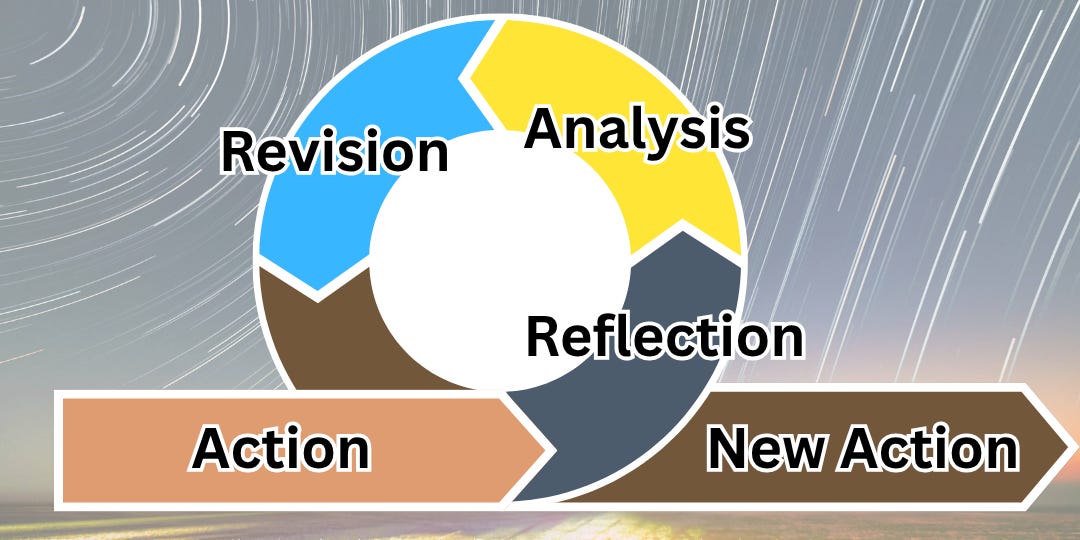
The loop requires a catalyst. Something has to prompt the evaluation step, because the evaluation itself is uncomfortable enough that no one performs it spontaneously. In a leader with substantial internal friction, the catalyst is built in. When a decision produces a poor outcome, you feel it. The discomfort is data, and the data is unpleasant enough to be worth examining. The examination produces insight, the insight produces an adjustment, and over time those adjustments calibrate into stable virtuous dispositions, what Aristotle called hexis. Hexis is the bridge between knowing the right thing and reliably doing it.
This is the structural problem with low-neuroticism leadership. Without internal discomfort, there is no native catalyst for reflection. The leader can choose to reflect, but the reflection becomes a discretionary activity rather than a forced one. When a strategy goes sideways, the unbothered leader’s nervous system permits them to file the experience under “things that happened” and proceed. The mistake does not sting, and what does not sting does not get examined. The next iteration looks remarkably like the previous one, and the leader’s judgment fails to compound.
Andreessen’s position is a particularly pure expression of this failure mode. He has not merely removed the catalyst. He has theorized the removal into a virtue and given it a slogan. Move forward. Go. The advice would be serviceable for someone whose judgment was already calibrated to an extraordinary standard. For everyone else, including Andreessen, it is a recipe for repeating yourself with confidence.
The Reality of the Low-Gain System
To be fair, there is a legitimate case for the low-neuroticism leader: the “Stoic Anchor.” In a crisis, a leader whose threat-detection system runs cold can act as a stabilizing force for an agitated team. It is entirely possible for these low-gain leaders to achieve rigorous praxis, but they must rely on external scaffolding like structured retrospectives, formal accountability mechanisms, and trusted critics to generate the feedback loops they don’t feel internally. The catch is that external scaffolding is entirely optional; a leader who feels no internal sting can easily cancel the retrospective or tune out the critic, choosing the comfort of organizational self-flattery over the hard work of adaptation.
Turbulence as Telemetry
I’m not always the leader I want to be, but I do know that when I’ve attempted to ignore or suppress the “turbulent” side of my personality, I became a worse engineer and a worse leader. Suppressing my nagging doubts didn’t fix problems; it just taped over my dashboard warning light. When I ignored that internal discomfort, I didn’t respect system risks, tuned brewing team frustrations, and let brittle systems ship. I made the exact same operational mistakes longer, carrying a high-confidence, zero-introspection stance right up until the moment of failure.
This is where the pop-psychology preference for the “Assertive” monolith falls apart. People who are totally self-assured and never doubt their own actions are rarely effective over the long term. True Aristotelian praxis demands a catalyst, an internal sting, sharp enough to force us out of thoughtless execution and into rigorous evaluation. The internal friction of the turbulent leader is not a bug or an emotional weakness; it is the automated telemetry of the praxis loop running in real time. It is the exact engine that compels us to trace a failure down to its root cause, refactor a broken process, and enforce an unyielding standard of excellence.
The ultimate irony of the corporate “Move Forward” ethos is that it is just as much an exercise in self-flattery as the personality test industry that follows in its wake. I don’t believe for a moment that Mark Andreessen never looks back at his own actions; the defensive insistence that he doesn’t reflect says it all. Yet, that performance of certainty will be quoted to other leaders. It will be written into handbooks on management theory. The dangerous myth that self-reflection is a structural defect will continue to be encoded into the very definition of leadership.
As a “turbulent” Commander who reflects a lot on reflection, let me suggest an alternative standard. The internal friction of high neuroticism is not a curse to be lifted. The urgency, the perfectionism, and the hypersensitivity to failure modes are the precise instruments required to navigate complex, changing systems. That turbulent signal is data. When we praise leaders who feel nothing, we aren’t praising resilience. We are praising a broken mirror that only reflects what the executive wants to hear. If you choose to lead without self-doubt, you will eventually find yourself standing in the ruins of a system you genuinely believed was perfect.