Techne Over Mania
The Greeks split creative work into inspiration you wait for and craft you can teach. AI made the waiting free, and the craft is what's left to manage.

This Simon Sinek and Ethan Mollick discussion is just one of a string of conversations about creativity that I’ve encountered in the last few weeks. Almost all of them are connected to AI. Whether humans are even necessary to the creative process, and if so what we actually contribute, is suddenly on everyone’s mind. The drawings, the poems, the marketing copy, the code. It all arrives polished and plausible, and it makes us wonder where we belong in this process anymore. Is the AI actually creative, or do humans add something the AI can’t? Can a business team use AI and still be creative?
Before you can ask whether AI is creative, or whether your team still has an edge, you have to do the boring, maybe even pedantic, thing first. You have to define the word. If the hardest thing in software development is naming things, then the hardest thing in business is speaking the same language. When people say “creative,” some mean novelty, others mean craft, and someone might have something more artistic or exotic in mind. We have to have a common definition for something that most people view as intangible.
Thankfully, creativity has a definition. A technical one, and technically correct is the best kind of correct. That definition is a great tool for understanding AI’s relationship to creativity, and where that leaves us humans. Oh, and the Greeks thought about creativity a lot too, so go ahead and fill in both free spaces on your Bingo card: I’m going to talk about AI and Aristotle as I dive into creativity for business leaders and teams.
What Counts as Creative
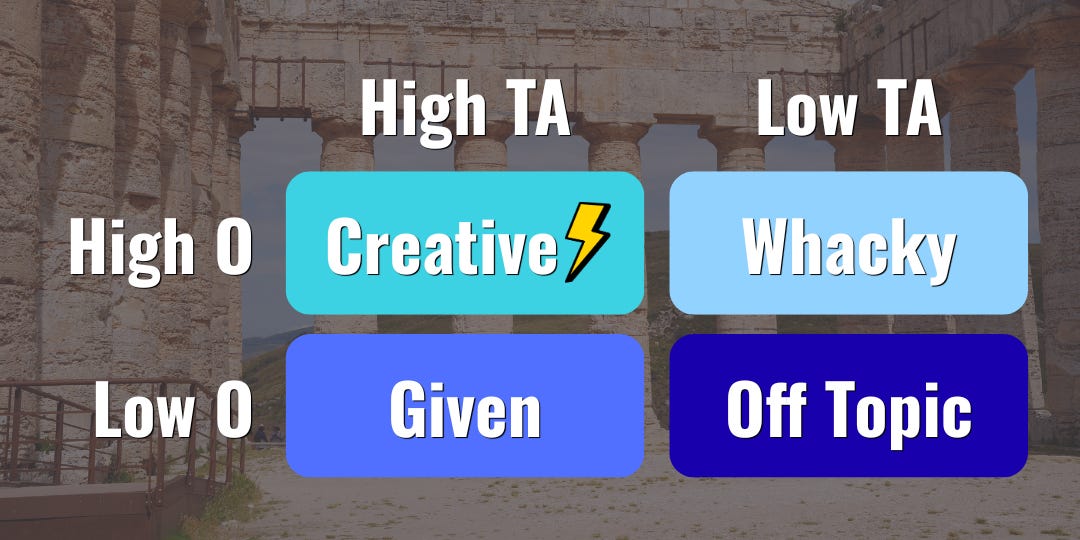
The first definition that I’ll introduce was created over seventy years ago. Formalized by Morris Stein in 1953, this formula for creativity is simple enough you could teach it to school children. To count as creative, an output has to be two things at once: it has to be original, and it has to be appropriate to the task.
Originality means novel, uncommon, unexpected. Appropriate means it actually works. It fits the problem, serves the purpose, satisfies the people it’s for. Both terms have to be present. Novelty without fit is just noise. A random string of words is maximally original and completely worthless. Fit without novelty is the opposite failure. It’s competent and forgettable, the thing anyone would have done.
The cleanest way to hold this is as a product, not a sum:
Creative value equals originality times task-appropriateness. The multiplication matters. If either term goes to zero, the whole thing goes to zero. You cannot make up for a total lack of fit by being more original, and you cannot rescue a derivative idea by polishing how well it works. Some people add a third term, surprise, the sense that an output violated your expectations and made you rethink something. I don’t really think “surprise” is a different factor from “originality,” so I’m throwing that in the bin.
This matters to someone who has to manage creative work rather than just admire it because it breaks down an immeasurable idea into aspects that can be quantified, even if still somewhat subjectively. Like many people, I tend to agree with Drucker’s view that you need to be able to measure something to prove it. Keep these two factors, originality and task-appropriateness, in mind as we look at how we should look at AI.
The Doxa Engine
A model’s default behavior is to produce the most probable continuation of whatever you give it. The most probable continuation sits at the statistical center of everything the model was trained on, so the output has a gravity to it. Prompt it and stand back, and it falls toward the mode. The first answer you get is, almost by definition, the most conventional one available. The poem that sounds like all poems, the safe phrasing, the startup idea that fifty thousand other people already had this week.
The Greeks had a word for this. Doxa, the received opinion, the common view, the thing everyone already takes for granted. That is exactly what the statistical center of the training data is. The unsteered model is a doxa engine. It does not hand you high originality on its own. Its output is weighted hard toward the conventional, because the conventional is what “most probable” means. What it makes cheap is volume. It will generate a thousand plausible candidates while you finish your coffee. In another video, Sinek mentions making teams generate a list of fifteen ideas, because the first four or five are conventional and the last five are bad, though some of those might have an interesting aspect buried in them. The AI will produce hundreds of ideas without grumbling about it, but that is not creativity. You may have to prompt it with your own original ideas before it generates anything that would budge the needle on originality. And the ideas it does generate are nearly worthless until someone aims them. Gallons of water are just potential. You need a nozzle to focus and aim that water before you have a useful firehose.
Task-appropriateness is that nozzle, and it is the reason so many people are reaching to talk about AI having no taste. Taste is task-appropriateness felt rather than calculated, the instant read on whether a thing fits, delivered faster than you could justify it in the moment. The model has none of it. It is bad at judging the appropriateness of its own ideas, even when you set it up to adversarially critique its output, which is why it will chase a rabbit hole without thinking or enthusiastically embrace a terrible business idea. Run the model through our formula and the result is lopsided. Originality, sure, by the bucket. Task-appropriateness is low and unreliable. Multiply the two and you land near zero: a thousand candidates and almost no creativity. If originality is the spark, task-appropriateness is the grounding reality, and in truth there has never been a shortage of new ideas.
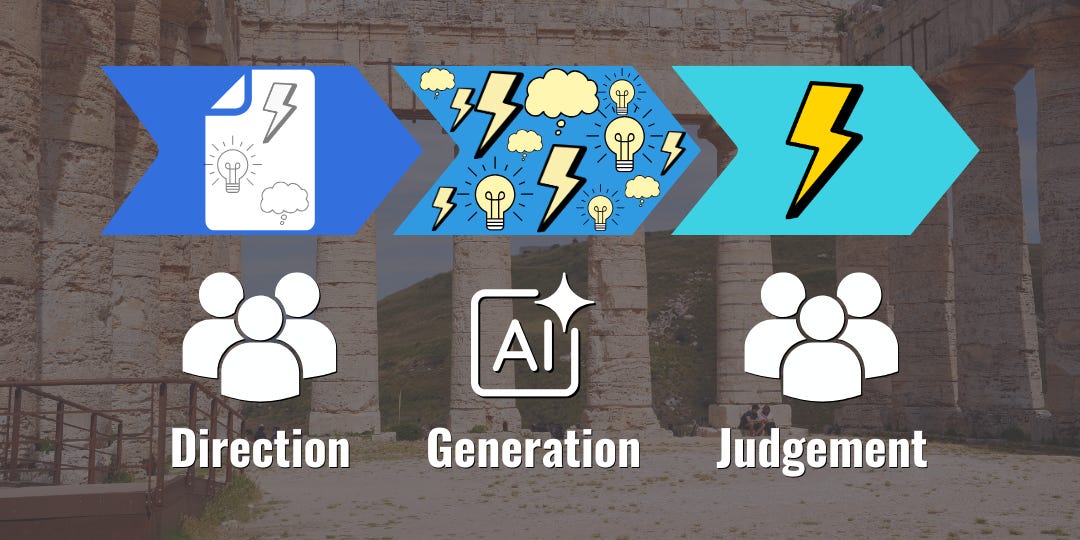
So getting anything good out of the model means breaking it off the average, and that break comes from you. Here is the part that is easy to miss. Task-appropriateness was supposed to be the second term, the filter you apply after the ideas show up. It turns out to sit upstream of them too. You need that judgment to steer the model toward anything original worth having, and you need it again to pick the keeper out of what comes back. AI may have shattered the bottleneck Sinek was working around, but it reinforces that judgment brackets the whole operation.
The romantic model of creativity, the muse, the spark, the divine madness the Greeks called mania, and the modern hype that says AI is creative because it produces novel-looking stuff, are the same mistake. Both worship raw novelty. Both ignore the half of the definition that does the real work. The scarce resource was never originality in the abstract, it was originality pointed at something. That is judgment, and judgment has an owner in the history of ideas. Enter Aristotle.
The Seduction of Mania
Aristotle built his theory of creativity in direct opposition to his own teacher, Plato, so the cleanest way to see what Aristotle offered is to see what he was pushing against. Plato had given creativity the most flattering account anyone has ever produced, and it starts with a single claim: that real creative work is not something you do, but something that happens to you.
In that account, inspiration is mania, a divine madness that arrives from outside and moves through the poet while ordinary reason stands aside. The poet receives the poem rather than reasoning toward it. What he makes is mimesis, imitation, because it was “copied” from the divine inspiration that was, itself, a copy of some divine truth, and Plato distrusted even that as a copy of a copy, twice removed from the truth and faintly deceptive for it.
Most modern thinking on creativity isn’t much different than mania. We think of creative ideas as something we just “come up with” or arrive like a lightning bolt. It’s reinforced by how it can feel in the moment; when you are in a state of flow and ideas are moving, it does feel like something is moving through you rather than something you’re grinding out. The connotations of divine inspiration are really flattering too. Who doesn’t want to feel like they had a divine inspiration no others could aspire to? Or that they simply are a creative person, one of the chosen?
But run it through the equation and the problem is immediate. The Platonic model is all spark and no account of fit. It celebrates the exact half that a machine can now flood you with on demand, and it says nothing about the half that’s actually scarce. At best, it treats creativity as a single indivisible gift, hiding the two-part structure that C = O × TA exposes. Worse, it puts the source of value outside the person entirely, by design. If creativity is something that happens to you, then you cannot teach it, schedule it, delegate it, or get better at it. There is nothing to hand to a new hire, nothing to put in a process, nothing to improve. The muse shows up or she doesn’t.
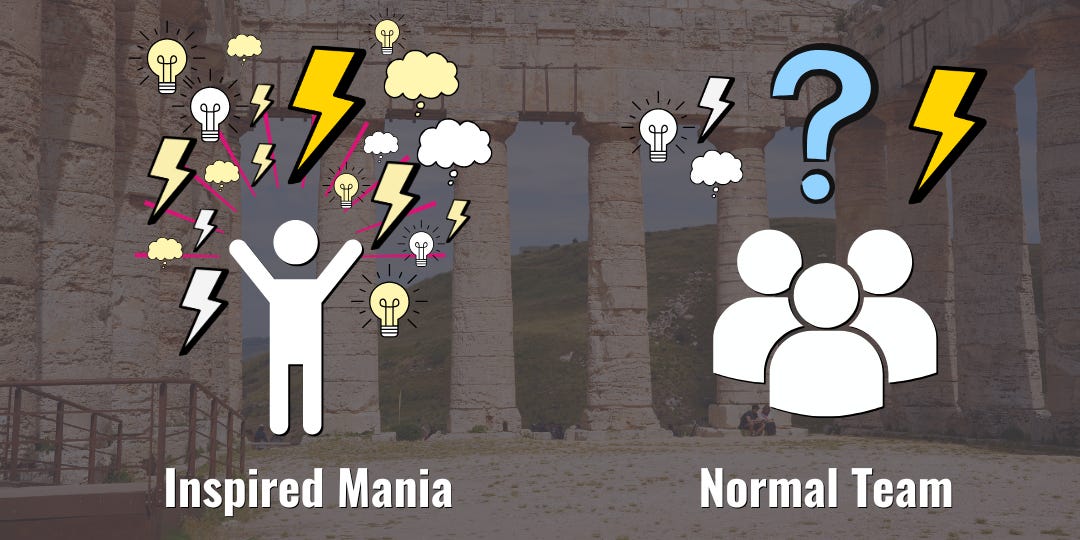
The muse and the chatbot fail in the same way. They just fail from opposite directions. One gives you novelty you didn’t earn and can’t repeat. The other gives you novelty you can repeat infinitely and didn’t aim. Neither one is creative, because neither one accounts for fit.
Creativity You Can Explain
Aristotle’s answer was to drag creativity down out of the sky and put it somewhere a team could reach it.
He refused to treat making as channeling. A craftsman who knows what she is doing can tell you what she is doing, and why this choice and not that one. She can walk a new hire through it, defend it in a review, write it down so the next person doesn’t start from scratch. Aristotle called that kind of work techne, craft backed by logos, a reasoned account you can actually give. The romantic asks where a thing came from and shrugs toward the divine. The craftsman answers the only question that matters once more than one person is involved: here is how it was made.
And that answer changes everything downstream. A craft you can explain is a craft a group can share, critique, and improve on together, where each person’s account builds on the last instead of dying with whoever held it. The muse offers none of that. She visits individuals, on her own schedule, and leaves nothing behind that anyone else can use. Aristotle is the first person in the Western tradition to put creativity somewhere an organization could actually reach, which is a strange thing to say about a man who died in 322 BC, but there it is.
The Master and the Veteran
Once creativity is something a team can reach for themselves and not the domain of the gods, the next question is what you are reaching for in the people who do the work. Aristotle’s sharpest distinction answers it, and it sounds academic right up until you have to staff a project.
He separates the master craftsman from the person of mere experience. The Greek words are techne and empeiria, but the idea needs no Greek. A person of experience knows that something worked. They tried it, it succeeded, they remember. The master knows why it worked, and because they know why, they can carry the principle into a situation they have never seen and get it right the first time.
This is the line between pattern-matching and principled expertise. The person of experience is trapped inside the cases they have personally lived. The master holds the underlying account, and an account travels. Here is the part that matters the moment you are building a team: the why is what makes expertise transferable. You can write a principle down. You can teach a cause. The “that worked once” knowledge dies with the person who holds it, while the “here is why it works” knowledge can become the property of the whole group. It changes what you hire and train for too. You can look for people who can say why, and grow that understanding on purpose, instead of stacking up veterans who have only logged the hours. I’ve written about “second order” thinking before, and this is the same dividing line.
It’s not quite fair (to either party) to say a language model is the same as a person of experience, but it fits in this framework. It has seen more cases than any human ever could, so many that even without grasping why something works, it can often produce a passable why anyway. It has “read” millions of explanations, so it can match the shape of one to your question and hand it back. That’s an explanation retrieved from experience, not a cause reasoned from principle. The veteran at least lived the cases he’s drawing on. The model is working from a copy of the written works of people, copied again into an answer. Plato would not be impressed.
Building Toward a Telos
Aristotle had a habit of explaining how anything comes to exist by asking four questions about it. For anything you are trying to make, ask: what is it made of, the raw material you shape? What is its form, the design or spec that exists as an idea before anyone touches material? What actually does the work of making it? And what is it for, the purpose the whole thing aims at? He called that last one the telos, and it does more than the others, but the one worth stopping on is the third: what does the work.
The obvious answer for a statue is the sculptor. Aristotle’s answer is the sculptor’s skill. She didn’t carve well out of nowhere; she developed that ability over years of doing it, and what someone develops, someone else can develop too. The skill is the real engine, and the skill is learnable. That is the whole point, because it means the ability isn’t trapped in one person by birth or luck. It can be grown on purpose, in anyone willing to put in the reps.
For a business that is a quietly radical claim. What actually produces your output is the capability your people carry, and capability can be built, documented, and handed to the next person. People leave. The skill can stay, if you make it something the organization holds rather than something locked in one person’s hands. So the money that looks like overhead, the documentation, the training, the process, is really investment in the thing that does your work. The irreplaceable hire looks like your safest bet and is really your most fragile one.
This is also where knowing why pays off again. Start from the telos - the finished thing you are aiming to create - and a master can reason backward to the next concrete move even in a situation he has never faced, because he understands the rules well enough to work out a path rather than recall one. The veteran can’t do that. Repetition tells you what worked before, not how to reach a goal you haven’t met yet. Working backward from the end is just planning, but it takes the kind of knowledge that only the master has.
What Mimesis Actually Means
The last of Aristotle’s tools is the one Plato got most wrong, and it draws the sharpest line in the piece between what a model does and what you do.
Plato dismissed art as mimesis: imitation, a copy of a copy. He heard the word and pictured tracing. Reproduce the surface of a thing and you get a hollow, degraded version of it. Aristotle heard the same word and saw something active. For him, mimesis is reconstruction. You build a model of how something works, how a person of a certain character would act, how an audience would respond, then run that model to see what comes out. One reading copies the output. The other rebuilds the mechanism that produces it.
Those two readings used to be an argument for art critics. Now they name the difference between your AI and your team. A language model is Platonic mimesis at industrial scale. It has read the surface of everything people have written and reproduces that surface convincingly, the copy of a copy from the last section, now running on every desk in the building. What it lacks is a working model of the person it is writing for. It can imitate a marketing email. It cannot simulate whether this one will land with this audience, because there is no audience inside it, only the statistical shape of a million emails that came before.
Aristotelian mimesis is the part you still have to supply, and if you build products you already do it. You model how a user will move through the thing, run that model in a prototype or just in your head, and watch where it breaks before you spend real money. That is what prototyping is. That is what dogfooding is. It is the discipline of designing around the person on the other end instead of around yourself, and it is how task-appropriateness gets manufactured on purpose instead of hoped for. You simulate the fit, find the failure, fix it before launch. The model can flood you with candidates. Only the simulation tells you which one survives contact with a real person, and running that simulation is still your job.
Creativity Was Never a Solo Act
That job, the simulating, the judging, the aiming, sounds like it belongs to one skilled person. The researchers who actually study creativity spent sixty years concluding otherwise, and they did it by building off of Aristotle’s work.
Stein’s 1953 definition told you how to judge an output, but nothing about where creativity comes from or what shapes it. In 1961 Mel Rhodes, working the same problem, mapped that territory into four buckets he called the 4Ps. Person, the traits of the creator. Process, the stages of generating an idea. Product, the thing that results, the artifact you’d actually score with Stein’s test. Press, the environment pushing on all of it. It structured decades of research, but it still had a central flaw, and it was Plato’s flaw. The whole map is drawn around a lone individual, with creativity happening inside one chosen head. Swap the muse out for personality traits and cognitive stages, and you have modernized the vocabulary without leaving the temple.
In 2013 Vlad Glăveanu reformulated it. Person becomes Actor, a creator embedded in a social role. Process becomes Action, externalized and visible. Product becomes Artifact, an object that carries cultural meaning. Press splits in two, into the Audience that receives the work and the Affordances the materials offer. He calls it the 5As, and every move pushes the same direction: away from the solitary genius and toward creativity as something distributed and shared, unfolding between people and the things they work with.
Actors in roles, taking visible action, producing artifacts that matter to an audience, working with the materials at hand. Strip off the academic vocabulary and that is a company. The consensus did not just drift away from Plato. It arrived at a description of organized work.
The Priesthood at Delphi
The Greeks already ran this system. The Oracle at Delphi was the most consulted source of insight in the ancient world, and the Pythia (high priestess) at its center delivered raw, inspired, frequently incoherent output. Nobody acted on it directly. A standing priesthood interpreted the raving into usable answers, and city-states made war, founded colonies, and wrote law on the strength of that interpretation. The inspired output was the famous part. The interpretation was the institution.
Put a model inside a company and you’ve rebuilt the arrangement. The researchers described a company; the Greeks staffed one. The AI covers the originality term, generating volume beyond anything Sinek could drill out of a room. A thousand candidates before the coffee cools. Your team is the priesthood, and it owns task-appropriateness on both ends of the system: the judgment to aim the question at the right problem and the taste to spot the keeper in what comes back. Run the multiplication now. Big O from the machine, real TA from the people, and for the first time both terms are large.
The oracle still has no taste of its own and never will. The easy conclusion is that this hands a premium to the rare individual who does have it, and in the moment, it does. An expert with a fast eye is a genuine advantage. But notice what that advantage shares with mania: it lives in one head, it works when that person is in the room, and it walks out the door when they do. Betting the company on it is betting on inspiration with better branding. A learned system is slower and less glamorous, and it works on a random Tuesday, with the gifted person on vacation, on a problem nobody has the instinct for yet.
The good news is that fast taste converts. A master’s read fires quicker than they can justify it, but they can still unpack the call afterward: why this one works, why that one dies. That unpacking is what a design critique is, what a code review is, what a serious editorial pass is. One person’s instinct gets decomposed into reasons, reasons get learned, and after years of that practice the team’s collective eye sharpens. Taste looks like a private gift, but it behaves like accumulated craft, built up by a tradition and carried by everyone working inside it. Judgment a group has turned into craft, the kind you can build, teach, and keep. That is what Aristotle meant by techne.
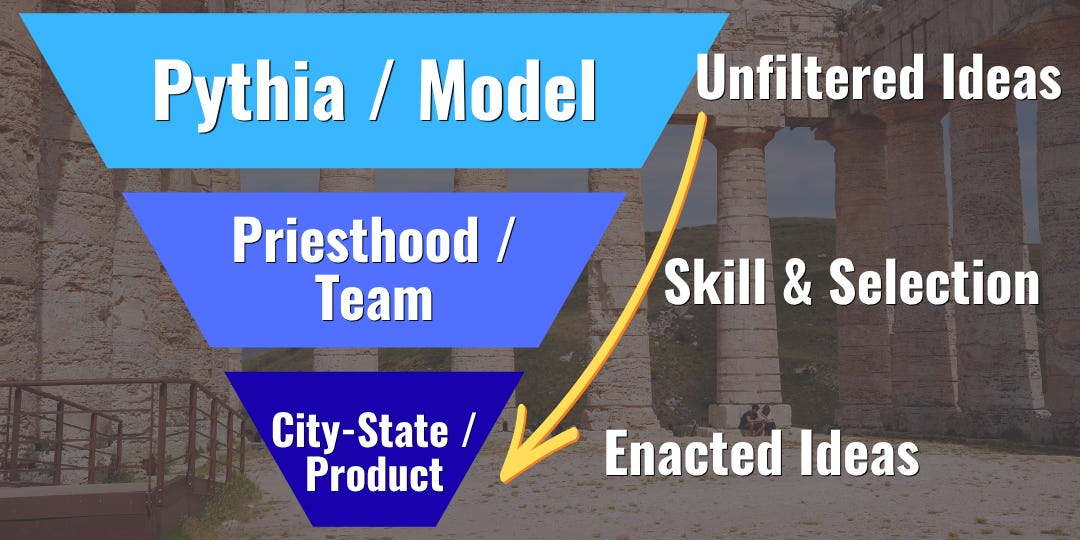
Never take the model’s first answer. The first answer it gives is the most conventional response available, so make wide generation the norm: fifteen candidates, thirty, more. Sinek had to drill his teams to push past five ideas because generation was expensive. It isn’t anymore, which means stopping at the first plausible output is a choice, and a bad one. Embed your ask with some taste; directing types of variation or sources of inspiration to consider. Then spend on the judgment side like it’s the product, because it is. Put critique, code review, and the editorial pass on the calendar as first-class work, not as the tax you pay before shipping, since those rituals are where one person’s taste becomes the team’s craft. Hire and promote the people who can say why. Simulate before you commit. Every one of these looks like overhead. Every one of them is priesthood work.
The muse never shipped anything on purpose. Neither will the oracle, left to rave alone. What ships the work is the teachable kind of craft, held by a team instead of trapped in a head, and Aristotle worked that out long before anyone got nervous about a machine writing their copy.